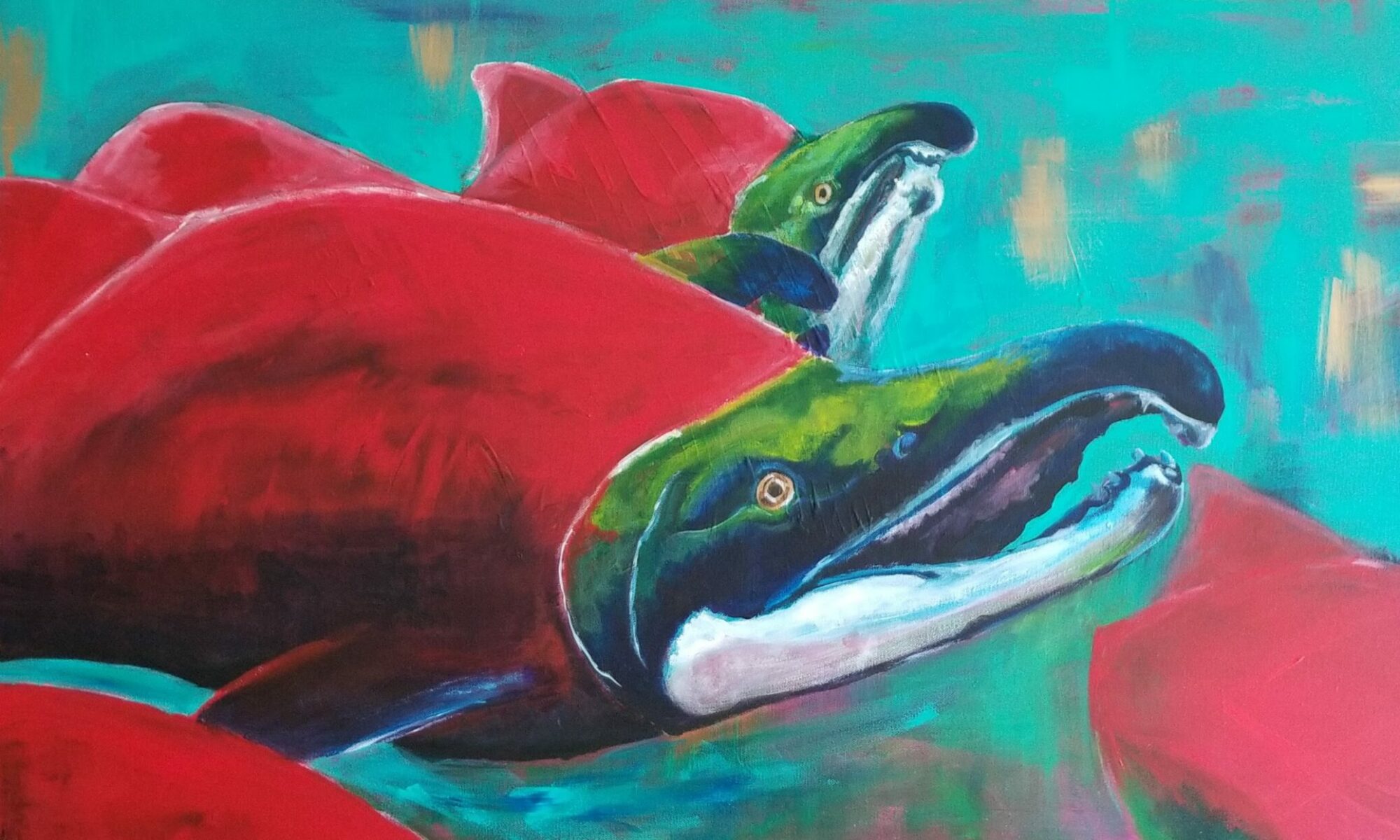
Lab 1 – A Walk
- Place: Canada, K’omoks Territory, Ryan St. Campus Forest, North Island College
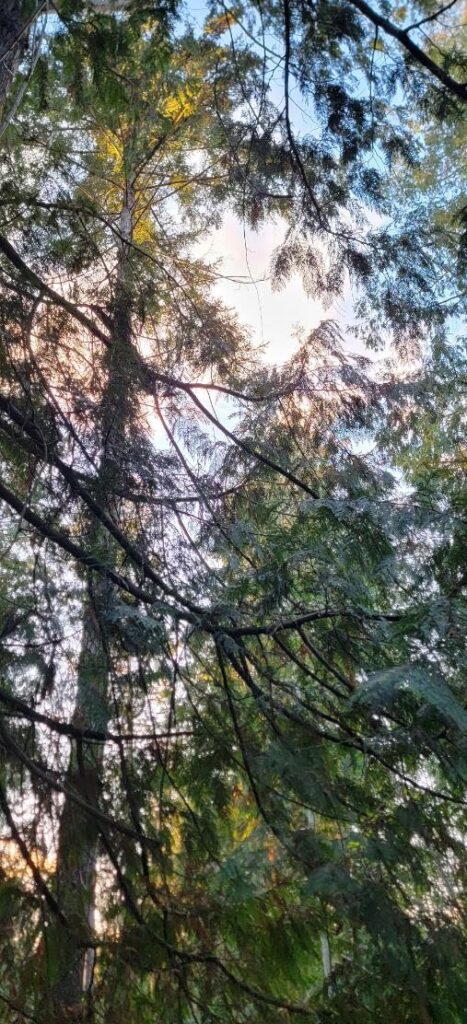
- A train in the woods, a forest habitat with wind blowing throguh the trees and birds chirping.
- Relative ease and natural soothing landscape
3. Touch
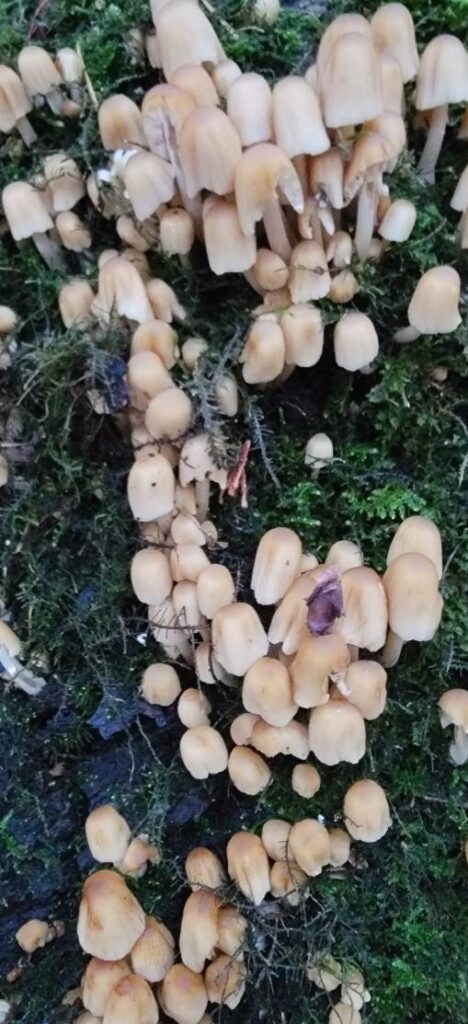
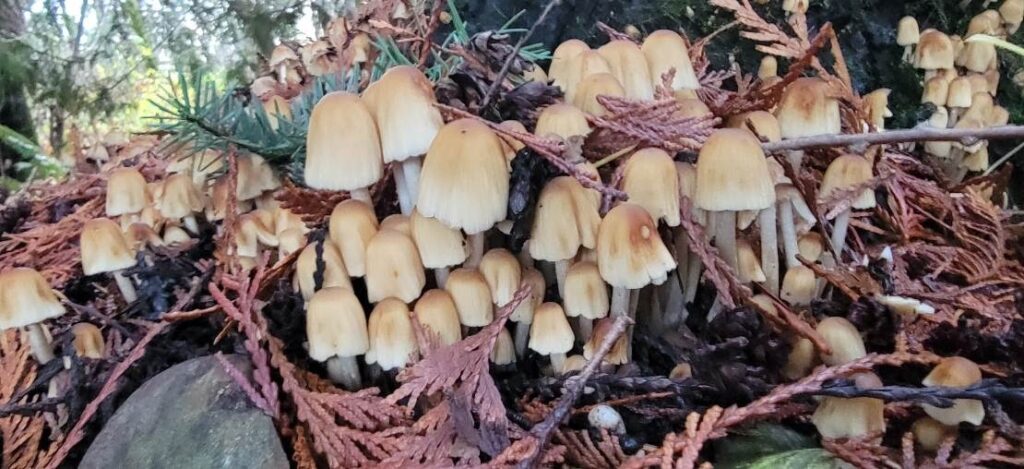
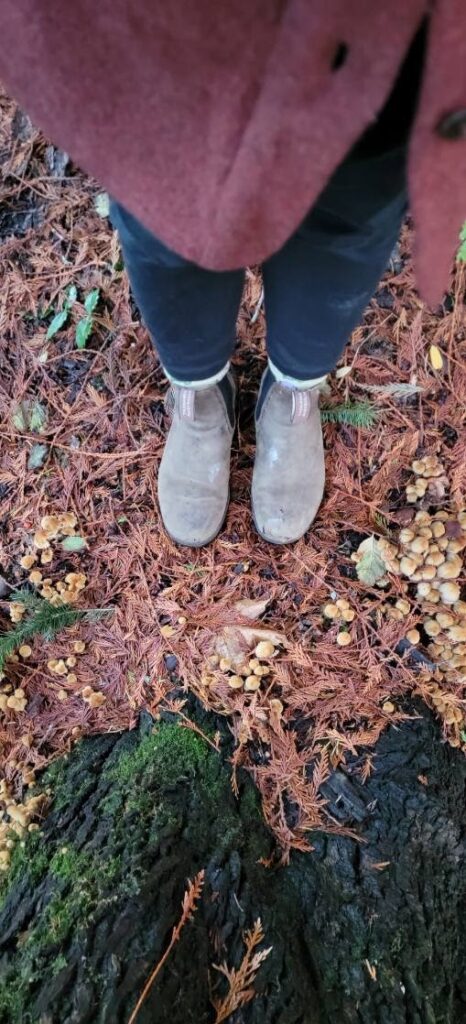
- Tree Bark: Rough and cold, what stories you may hold, with textures deep, your grooves surely haunt me in my sleep
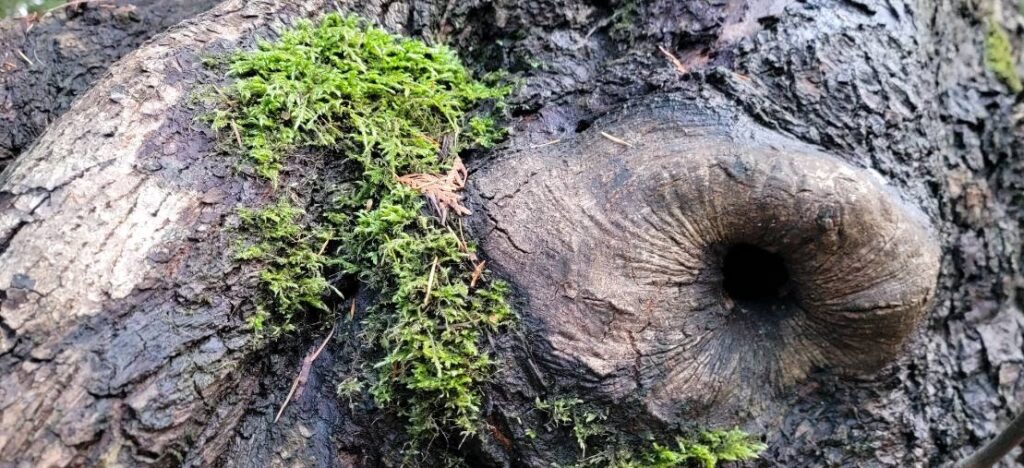
- Moss: Fluff and warmth, how varied you are, lining on the edge of an elephant’s truck, like a carpet upon the dark
- Cool breek cuts deep, shivers reflect both sense and spirituality, here I feel my truth, surrounded by my roots
4.
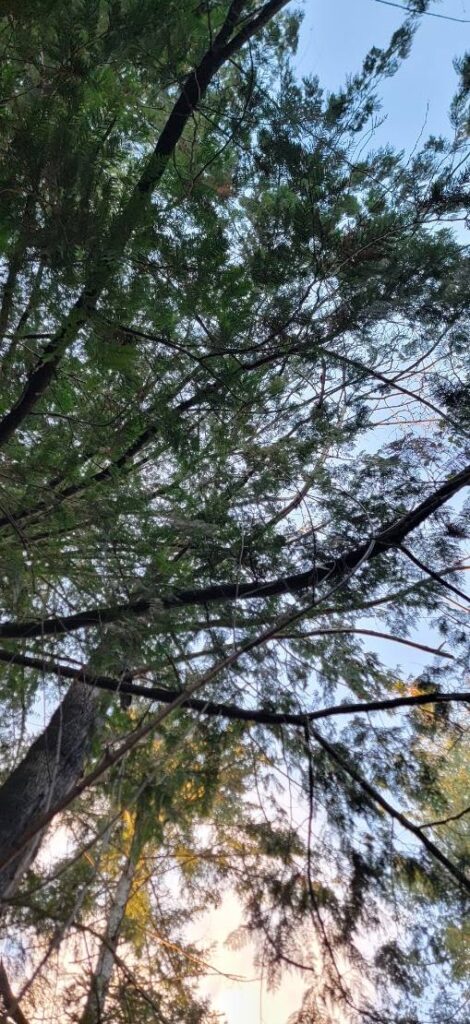
- Colour green light and dark fluxuates like my heart. In and out, soft on rough, but nothing smooth but a chopped of limb.
- Brittle of bark – fresh of green
5. Hear
- Wind
- Engine
- Bird chirp
- Branches rustle
- Crack and thud
- Wind swirling
- Breath
- Ballpoint pen
- Wooshing wind
- Engry engines
- Busy birds
- restless branches
- violent cracks
- dancing winds
- rhythmic breath
- scratching pen
Rythmic Breath

- up and down
- in and out
- cold and warm
- broken rhythm
- Continuous
6. Smell
- Dog dandruff mixed with decaying leaves
- Earth and comforting, like renewal.
7. Action
- Brittle and acidic, crunchy and cold, chewing chewing, getting old. Swallow deep, get it down, medicine, I’m sure to frown.
Lab 2 – Partida for Eight Voices
The piece started out very chaotic. The volume was loud and the unharmonized voices was overwhelming. The speaking coming from seemingly all directions was reminiscent of the “monkey mind”. In other worlds, it felt like there was so much busy speaking and voices talking over one another I could barely make out what anyone was saying. It reminded my of how I feel when I’m unaligned. Yet, I did happen to capture that they all seemed to be talking about mathematics equations. Then, as the piece progressed they manage to speak more and more in synchronistic, eventually erupting into harmonious song that was very pleasing to the ear. It reminded me of religious choir music. It felt elevating. The contrast of the chaos with the harmony made the piece feel more impactful. The voices did speak again but when they did they were speaking about the same thing and eventually speaking at the same time. Finally they returned to song and I was lulled back into the soothing euphony. It felt like a massage for the brain.
Music I suggest for concentrated listening include the following two pieces:
- Once it’s all on the ground – by Lake Mary, Paul Dehaven, and Jordan Knecht: https://open.spotify.com/track/53CkZJnv3UiTyKrU27isAx?si=ae1241f6816a43ff
- The Beauty of Sorrow – by Pauline Oliveros: https://open.spotify.com/track/078txIRiyvxbjjYesA9qy6?si=779b7dae36a246d0
Feedback to Zoe Pigot:
https://open.spotify.com/track/1SlaYIznNpoMqq407EL9NR?si=jeuUB4grQVe-X3vzpDKCkA
Hi Zoe! Thanks for sharing your music. I listened to me and jesse [part one] and found it… well, surprisingly stressful. Maybe it’s just the state that I’m in and I’m projecting, but I felt this constant rush throughout the whole song. While the softer plunking notes did add moments of a lighter excitement, the pace of the song made me feel rushed! Maybe that’s the excitement that is being created in others and I’m reading it in my body as anxiety. It’s interested how anxiety and excitement are such similar feelings in the body. I wonder how much of the distinction between the two emotions falls to choice.
Feedback to Aaron Brenner: Ben Howard – Promise
Thanks for sharing these artists Aaron! I listened to Ben Howard’s Promise, and while I’ve heard it before, the intentional listen brought up some new feelings towards it for me. I found the static sounds at the beginning to be very interesting. I noticed the other song you recommended by Flight Facilities does a similar thing and I wonder if this is sort of like a “hook” for audio artists to start to generate interest from the listeners. The rest of the song was also beautiful, I’ll admit! It made me think of my kitty. Like who am I to deserve such a sweet unconditional love! hehehe. I also noticed that the steady vibrational hum that was happening in the background of the song made the composition feel really “full”. I’m not sure how else to describe it, but it’s something I noticed while listening to Benj Rowland play the Hurdy Gurdy too. It feels comforting, like I’m being wrapped in warm blanket.
Check out Ben Rowland playing the Hurdy Gurdy here: https://open.spotify.com/track/45Cenag2nhM5MZKftdYHM5?
Video Edit Practice
Video editing practice: https://youtu.be/bKFNK0yt24I
Artist Research – Yoko Ono
- Where were they born? Where did they grow up? Where do they live now
- Japan, 1933
- she moved with her family to New York in the mid-1950s and enrolled at Sarah Lawrence College. Over the next decade she lived in New York, Tokyo, and London, greatly influencing the international development of Fluxus and Conceptual art.
- At Sarah Lawrence College in Bronxville New York she studied writing and msusic
- Currently living on a rural farm in upstate new york after living in NYC for 50 years
- Ono was born into a banking family who suffered from starvation during World War II. They were often forced to barter household items for food while they sought refuge from Allied bombing raids.
- Where did they study art? Or are they self-taught?
- At Sarah Lawrence College in Bronxville New York she studied writing and msusic
- In 1952 Ono became the first woman admitted to the philosophy program at Gakushūin University in Tokyo, but, after about a year there, she joined her family in the New York City area, where her father, a bank executive, had been transferred.
- What kind of art do they make?
- Conceptual and performance events
- Many of the works she created during this time existed primarily as written instructions for others to carry out or, in some cases, merely to muse upon. Ono later compiled these epigrammatic texts—Lighting Piece (1955) offered the direction “Light a match and watch till it goes out”—in the book Grapefruit (1964). Interested in the integration of art with everyday life, Ono became associated with the Fluxus collective, and in 1961 the group’s founder, George Maciunas, provided her with her first solo gallery show.
What are the formal aspects of their work (colour, pacing, composition, genre, style, etc)?
- In a performance hall space of the Louisiana Museum several men walk into the room with an object bundled in a black sheet. They place the sheet in the centre of the stage and reveal what it is by pulling back the folds to expose primarily off-white and colour speckled ceramic pieces. At this point, Yoko Ono walks onto the stage and take a microphone where she proceeds to make loud noises. She screams and yells and makes varying sounds into the microphone for about 40 seconds (13:22 – 14:01). She immediately proceeds to say “I just wanted to clear the air” to which the crowd errupts in laughter and applause.
- In the background the words written in Japanese from her previous performance drip in black ink on what appears to be 8 foot tall canvas panels. In her previous act she shares a story of her life and culture and explains what the words she has written says to the audience, “Give us 7 happiness and 8 treasure, pray for you.”
- She introduces the piece sharing the name, “this is called promise piece, and well there are a few promise pieces, but this is one.” She explains that the broken pieces of ceramic on the black fabric on the floor were exactly like “this” and she points to a large vase that stands almost as tall as her waist. The vase is white with blue and pink. It’s difficult to see the markings on the vase, so I’m assuming the imagery on the vase is not of impotance to the piece. She explains that now the vase is destroyed. She says that she would like “you” (members of the audience) to take one piece each, “and in 10 years we meet again and put it back together again into what it was.” She says thank you and exits from the stage.
- The darkness of the silhouetted audience mirrors the dark writing on the back of the stage
- The warm lighting on the stage makes the space seem inviting and welcoming.
How do these formal aspects affect how you “read” the artwork?
- Yoko has taken a formal space (a museum) that is normally reserved for history and art and little more engagement from the audience than viewing ancient pieces, and created an informal welcoming space where people can come on stage, touch, and even bring home pieces of the experience. But there is a responsibility that comes with taking a piece – a commitment to action by returning in 10 years and engaging in the difficult task of putting together a broken vase. She uses humour and personal storytelling and an inviting challenge to engage her audience. Her bravery of sharing a vulnerable story in her previous act, feeds into the broken pieces performance setting the stage for her next courageous act: yelling seemingly relieving sounds into the microphone. Her performance demonstrates trust to the audience – her faith that they will meet again and continue to be a part of each others lives. In this way she gives not only a physical a gift but the gift of belief in her audience.
What is the imagery explore?
- The power of belief, an expression of faith, and the generation of good energy
- What is the context for this work (can you make a connection politically, theoretically/philosophically, in the art world, in their personal life)?
- There were three acts in this show, the first of which was Ono’s legendary performance “sky piece to jesus christ” followed by her “action piece” painting, clearing the air scream, and then the “promise piece”
- She mentioned this is not the only Promise Piece. In fact this performance has been going on since 1989. In this way Yoko Ono is making connections with potentially thousands of her audience members from around the world: 1966 London, 1989 Paris, 2009 Venice, 2014 Florida and more. Normally Yoko destroys the pot on stage but for this performance it was already broken.
- Yoko shares that her life is full of difficult experiences. Her early life includes experiencing hunger and near starvation during the second world war as a child. she moved to the states during a time where there was likely a lot of racism towards Japanese people. The piece is likely an invitation for all viewers to become active participants at reconstructing the beautiful but fragile vase. Perhaps the vase is a symbol of holding – whether water, nature or one another. The vase is a cultural object and has had important ceremonial purposes in cultures (i.e. ancient greece among others). Perhaps this is an invitation to reconstruct, together, a culture that has been broken and shattered.
What ideas does the work cultivate, or questions does the work ask you to consider?
- How will they know how to put it back together?
- When and where will they all return to put the pot back together?
- Will Yoko Ono facilitate the audience putting the pot back together?
- Does she really believe people will come together to put it back together?
- What is the value of trust and belief?
- How is she building connections with her audience? Do they trust her as much as she trusts them?
- What does the audience think/believe about the piece?
What emotions does the work elicit for you?
- Curiosity, doubt, worry, hope
What does the artist say about their own work?
- “All my works are forms of wishing”
Is there anything about this artist’s work that interests you? What and why? If not, can you articulate why that is? What is missing for you?
- I am drawn to the artist and her work for several reasons: 1) it’s political 2) it’s personal 3) It’s engaging and encourages audience participation 4) it’s open enough for the audience to walk away reflecting on the deeper meaning.
- Finally, I have to say, that when I was experiencing some of the most difficult times in my life, it felt like all I wanted to do was scream as loud as and honestly as I could. But I didn’t have the courage to do so. I didn’t feel safe enough to do so. But Yoko did. She still does. She’s still screaming into microphones in front of rooms full of people and for that, she’s a bloody inspiration.
Is there anything about this artist’s work that you can carry over into your own art practice? What in particular?
- Oh man. This is so deep and fascinating and inspiring! It truly makes me want to engage the audience more in my artwork. How can I empower my audience and leave them feeling deeply connected to one another? I think I could ask myself that question for every piece that I make.
Include the links to the websites you obtained your research from:
- https://www.pbs.org/newshour/arts/burn-story-yoko-ono-youve-read
- https://www.moma.org/artists/4410
- https://nypost.com/2023/02/24/yoko-ono-leaves-nyc-for-a-farm-she-bought-with-john-lennon/
- https://www.britannica.com/biography/Yoko-Ono
- https://www.xibtmagazine.com/2022/01/ekphrasis-the-self-curated-film-performance-art-of-yoko-ono/
- https://www.youtube.com/watch?v=-PZqi1oPXHk&t=783s
- https://www.fondazionebonotto.org/en/collection/fluxus/onoyoko/4/1292.html
Video Poem Brainstorm
What is the concept I want to communicate?
- Cancel Culture?
- Shame – speaking shame
- Freedom through expression
- (IFS) parts of self
| Haiku | Image brainstorm |
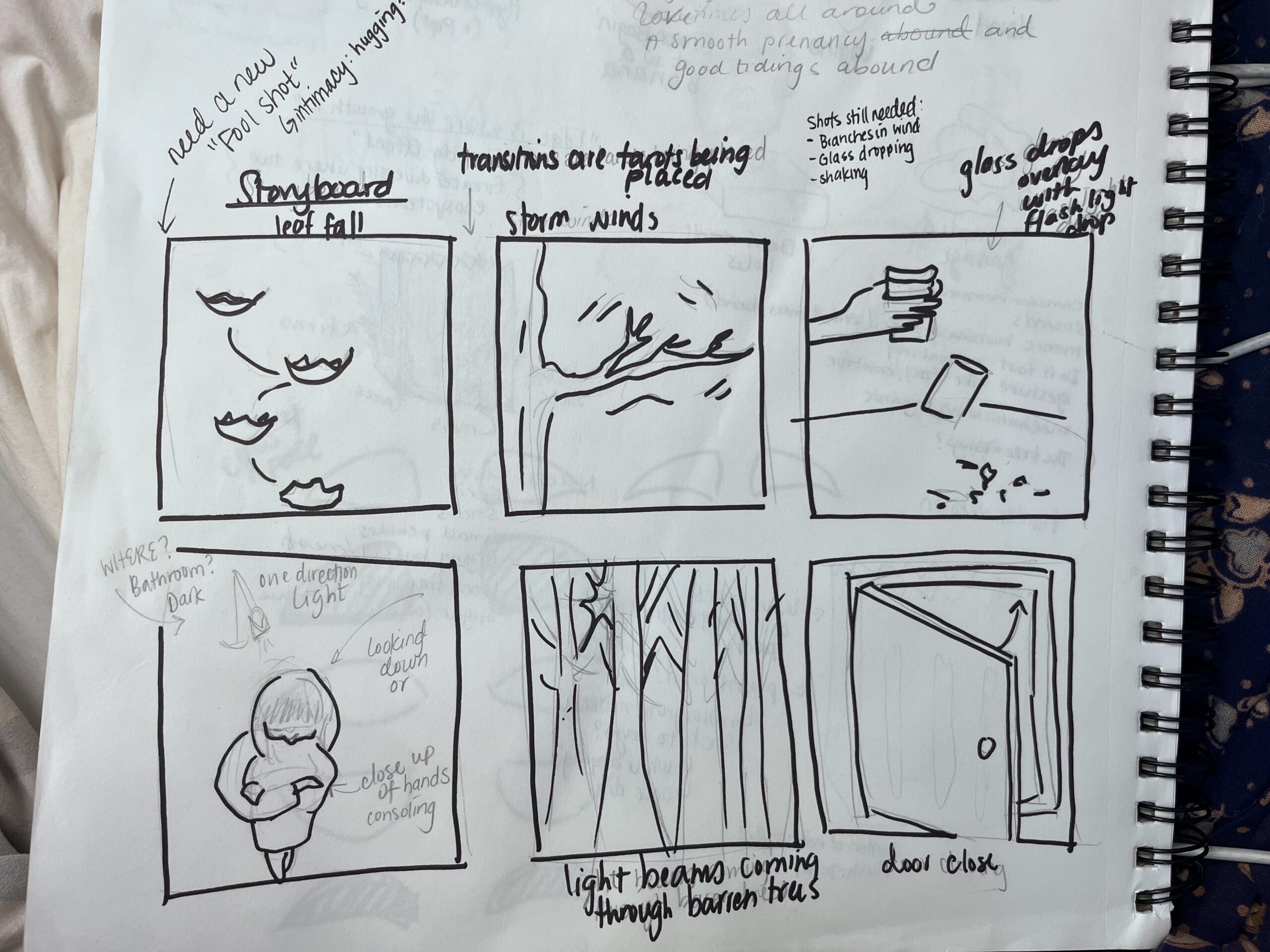
| So light, delicatebut under it’s weight trees crackRoofs collapse. Hearts failAuthor unknown | a leaf fallingtree branches moving in the windWater rushing in the riverhand reaching out from the waterglass shattering |
| I did, I admit Fell victim to my weakness Fear, alone, shame, shame Arielle Houghton | Signed documentfalling to kneesholding onselfLooking downwardsthen looking upwards to the light |
| But nothing could kill a faith like a guillotine, as heavy, as light. By Rachel Wetzsteon | lights coming through the trees of the foresteyes closingdropping a flashlight in the darkknife cutting a carrotA door closing |
I did, I admit
Fall victim to condition
Part of me, not true
Arielle Houghton
Video Poem Process
The equipment I rented for the project started with a Gimble. After taking it home and watching the instructional video that was linked by QR code to the packaging, I started to test the equiptment by walking around my block at night. Getting used to the turning function, the recording button, and some of the other features of the Gimble was tricky at first. Some of the functions shown on the video didn’t seem to work on my iphone, but it functioned well enough. This is when I found the fallen down sunflower shot, and took the door closing shot that would end up in my video. There was some 8 other clips that didn’t make the cut. The next morning I captured the video of the leaf falling. I tired capturing the natural falling of the leaf, and staging it by throwing a leaf in the air, but because of my relative closeness to the leaf, it moved too quickly out of the frame.
After taking that footage, I put it on Adobe Premier and started to work with the clips. I noticed that the footage was shakey, despite using the Gimble. Maybe I wasn’t using it correctly? In any case, Tyler showed me how I could stabilize the image using Premier Pro editing features which was a huge life saver. I also noticed that much of the shots taken in low-light looked quite grainy. I wondered if this was due to the quality of video on my phone. I noticed that my classmate, Ally, had really clear and crispt underwater shots and made a mental note to try taking some footage with the GoPro to see if I could capture some better images.
After the sharp learning curve of using Adobe Premier, and many hours in the Mac Lab, I had ordered the clips and begun to cut them down into reasonable lengths. This would be the extent of my edits for my first Mac Lab session.


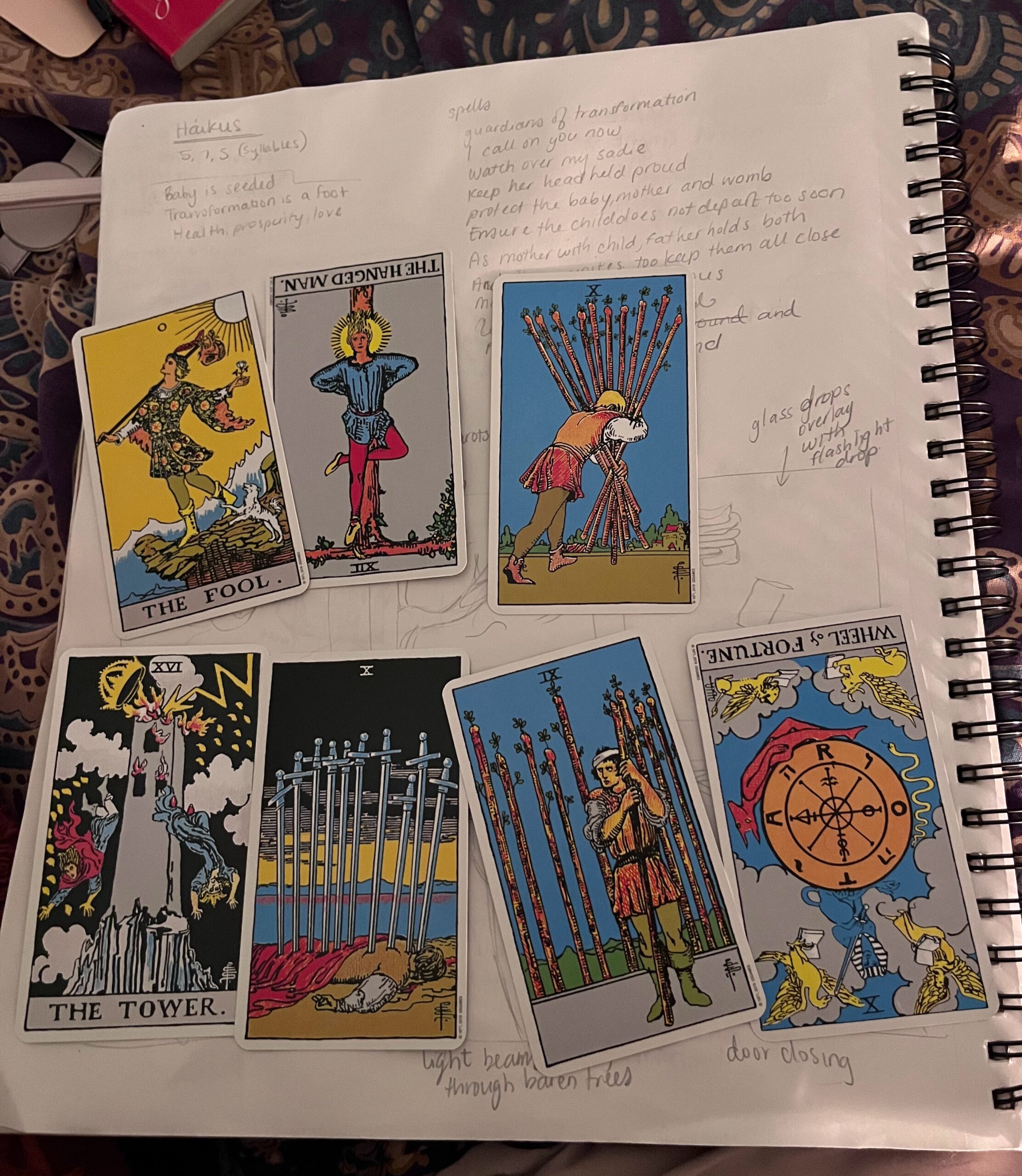
In doing my edits I also made not of where I still needed shots. This included an opening shot and shots to go along with the “climax” of the video – the Tower Card. I brainstormed what I could do and decided I would go with a water theme after being inspired by my classmates underwater shot. Originally, I thought I could try and drown myself in the ocean (figuratively speaking), but then I thought that perhaps I could have a better effect (and warmer) in the bathtub. This would not only be more comfortable for me, but baths are one of my most comforting activities and simply stepping into the bath would mirror the image of the Fool – stepping forward towards the cliff. I was headed to my dad’s house in Victoria for the weekend so I could use his bath, and I packed a yellow oversized shirt to mimic the yellow tunic in the Fool’s card. I still wanted to incorporate some underwater shots of the ocean though, I thought I could do this for the “drowning” part – a self point of view of what it feels like to be thrashing under water. I also knew there would be a storm that night so planned to stay up late and capture some shots of the wind shaking the trees like I had planned in my storyboard.
Half a dozen selfies and video clips later I had my successful shots of stepping into the bathtub and drowning. I played with the idea of looking up at an unknown figure, but decided in the editing phase that it looked better if I was along and uninstructed.
Trying to use the GoPro was difficult. I needed. to watch some YouTube videos on how to change the settings on the camera, and almost all of the batteries (all three of them), were dead and I didn’t have the appropriate apparatus to charge it. Also, Tyler told me that the integrity of the camera was compromised, so I needed to be really careful that I didn’t get any soap in the water I planed to submerge it in. I wasn’t sure if there was any left over soap in the tub, but I didn’t want to risk having to pay hundreds of dollars to replace the equipment so I continued to use my phone in the bathtub shots. Fortunately, I have my own tripod, so I used that for these clips.
After the tub, I went outside at midnight to capture my storming trees in the wind shots. It was very dark and there was a street light sillouetting the tree in front of my dad’s house. It was moving pretty agressively but I wasn’t sure if the GoPro was working well enough to capture the image in the dark lighting. I tried to take the shot, went inside, checked it, and then went outside and took it again with my phone. This seemed to work better.
My next step was to capture some footage of the glass breaking. This was going to be the most staged clip since I knew I needed to do it somewhere away from my cat (so it couldn’t be at home) and with really good lighting. So, I asked Jeff where he’d recommend I do it on campus and he recommended that I do it in the painting/drawing studio and use objects to try and prevent the glass from shattering all over the room. He also provided me with a brook and shop vac to clean up after myself. I brough my shadow-box light to class with me on Tuesday and after class I set stage up in the corner of the room. I used the plinths and painting boards to block in the glass and set up the light. I used AI to look up what settings on my phone I should change to be able to capture the best shots. It said to go to 60 frames per minute (second?) and to 4K video quality. Maybe I should have been shooting at that quality all along? Anyway, I changed the settings and then set my phone up on the tripod.
I dropped the glass but the first try it bounced out of the frame and didn’t break on the cement floor. Fortunately, Yeun Ting was in the room while I was trying to take my shot and she recommended to drop it from the top of the glass where the glass was probably thinnest. She was right! The second take it worked and I had my footage! Success. That shot felt really important to the story arc and was the most technically challenging shot of the video.
The following day I returned to the Mac Lab to process my next round of shots. I still didn’t get the clip of the underwater ocean scene but I figured I could work with what I had. Unfortunately, not of the technology was working. I stayed for hours trying to trouble shoot, sent several emails, but still couldn’t get Premier Pro to work. I had my 3D art class next and we were also using the computers for that class. It turned out that Premier Pro wasn’t the only program that was suffering so on Angela’s suggestion I sent emails to Sara, Scott and Tyler to tell them about the issues I was experiencing and possible causes. After my 3D art class I tried again on two other computers but still struggled. I decided to watch a few how-to videos and try and find some sound clips since I couldn’t edit the video. After listening and downloading about 6 different songs from Pixaby and watching 5 how-to videos, I threw in the towel and went home.
The next morning Sara was offering additional assistance on the video. At this point it was Thursday and the last day before the assignment was due. I knew if I didn’t get my underwater shot before going into the Mac Lab, then it wasn’t going to make the video. So, all dressed up in my halloween costume, I headed to Puntledge River with the Go Pro. As I approached the river I saw the salmon running and hundreds of seagulls! The river was much higher and moving fast. Perfect! I put down the camera and then… shoot! I forgot to try and find a wall charger to charge the Go Pro batteries! I prayed that one of the batteries had enough juice to get the shot. I tried all three batteries, changed the settings to go to video, and then put it back in the case, I submerged it in the water, moved it all about in the surface of the water, and then pulled it out. I looked at the camera but it was dead. When I got to the lab I saw that there was no footage captured. What a bust!
Back in the lab Sara Vipond had been trouble shootting the technical issues with the computer. With her support I was able to get onto my video and add the new clips I had taken. I clipped and cropped them and got them into order. Now I was onto editing the transitions. This took the full 2.5 hours of the Mac Lab time before I got kicked out for the next class using the space. I headed to my volunteer job and settled on completing the project before class on Friday.
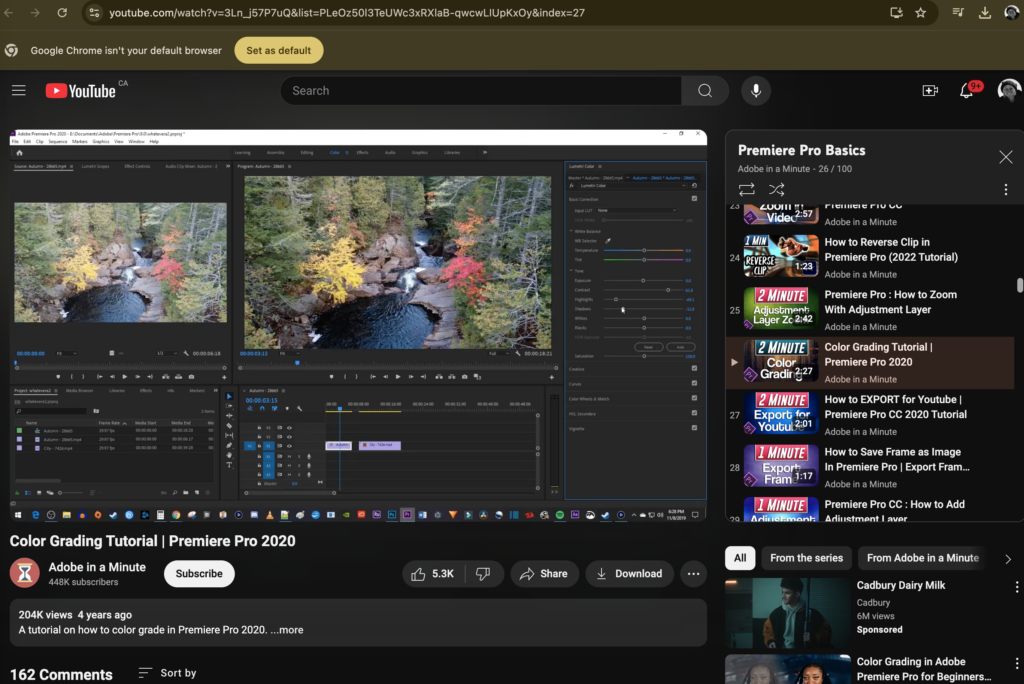

It was now Friday and I still needed to added the sound clips, finish editing the clips for colour, and slowing down and speeding up some shots. Fortunately, Ally was also in the Mac Lab making some last minute changes and I have to say, the moral support was much appreciated. She was in the lab almost every time I was and it was great to be in this whole challenging project together. I’m grateful for her and for managing to complete my edits with the hair on my chinny-chin-chin – completing the project just 30 minutes before it was due!
Video Poem Project – The Fool’s Journey
The Fools Journey
Two years ago I had a traumatic experience. As this project began, I went to a workshop to help open my blockages around communication. During the workshop I broke down in tears realizing I still struggle to speak my truth about what occurred two years ago. I decided to make this project a non-verbal way of communicating what happened from my own perspective. I wanted to share how I felt moving through that experience. I wanted to convey how it seems like what happened was a part of some bigger constellation since, at times, I felt like I had zero control over what was happening in my life. But, the truth is, I did have a role and that role was the Fools Journey. I’ve been playing with Tarot Cards and used the cards to tell my story. The Tarot Cards begin with the Fool and so that’s where I wanted to start – someone innocently galavanting on a big adventure, unaware of the looming cliffs. The tarot cards are filled with symbols with multiple interpretations. This represents how many people can have different interpretations of a single experience. After so many years I’ve never been able to tell my version of the story and this project has brought me one step closer to doing so.
I wanted to the climax of the video – the drowning and glass shattering of the Tower Card, to fall silent, to represent how during the most painful moments of my experience, I felt silenced. I chose to drown myself in a bathtub, because it did feel like my experience was a part of my own doing, no one forced me into the water, I walked in willingly. No one held me beneath the surface, I was the one trapping myself there. In this story I am both the victim and the perpetrator. I hold both roles, the same way one card can have different meanings depending on if it’s in the upright position, or the reverse.